
Senefelder Endowments honor innovation, progress, and continued investment in graphic communications education through scholarship support that helps students pursue careers in the evolving print industry.
The Robert Klause Memorial Scholarship
RAISE Foundation/Printing Industries Association of Southern California Scholarship
The Harry and Thomas Brinkman Scholarship
The Henry J. Schooley Memorial Scholarship
The Allen Halvorsen Scholarship
ePS endowed scholarship
Pacific Printing Industries Education Trust endowed scholarship
The Steven Pundt Memorial Quick Printing Magazine Scholarship
PIA of Kansas City/Ray and Anna Campbell Scholarship
Konica Minolta Business Solutions U.S.A., Inc. (KMBS) Scholarship.
The Donald Rothrock Memorial Scholarship
Richard M. Worthington / NALC
Joseph Genstein Memorial Scholarship
Frederick Rogers Scholarship/Research & Engineering Council of the Graphic Arts Industry
Warren D. Hanssen Scholarship
The John Berthelsen Scholarship
Ben Franklin Society
Virginia Shea Memorial Scholarship
The Wayne “Bumps” Brown Scholarship
Time Inc. Production Scholarship
The Sheridan Group Scholarship
The Robert Zunk Memorial Scholarship
The Ernest Shea Memorial Scholarship
Ash Khan Legacy Scholarship
The Marcus Family Foundation
Michael Bruno/TAGA Scholarship
John and Grace Goessele Memorial Scholarship
The Society of Fellows Scholarship
MEGTEC Systems Scholarship
James Bucchin, Jr. Memorial Scholarship
The Order of the Black Leaf
Central Wisconsin Club of Printing House Craftsmen
The James Shields Scholarship
Twin Cities Graphic Arts Memorial
Bruce Tietz Endowed Scholarship
Rae Goss Scholarship
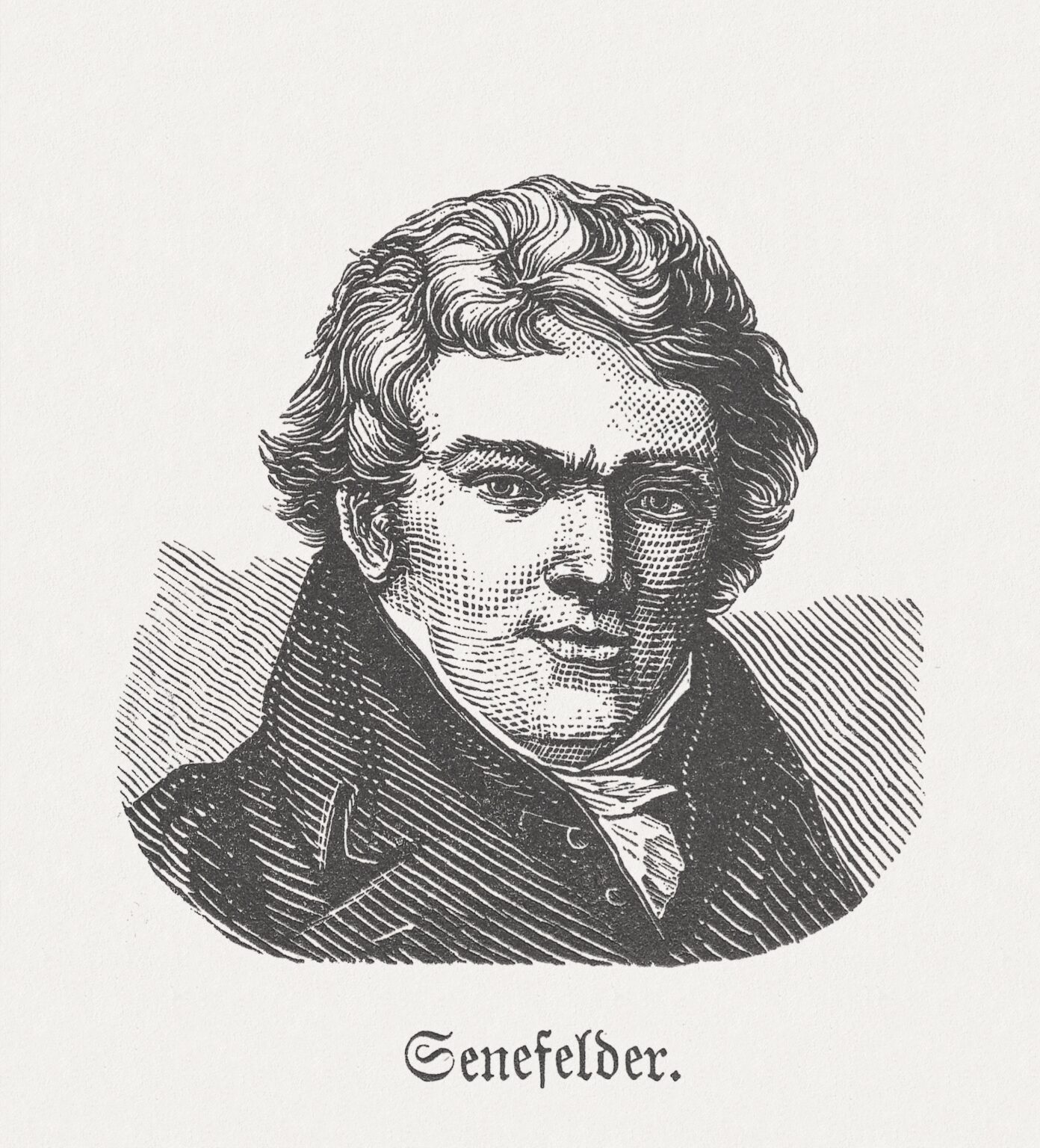
Alois Senefelder of Germany was the inventor of lithography. His invention of a new printing process came about by chance while he was seeking a method of reproducing plays and musical scores. Writing in reverse on a piece of limestone with greasy chalk and then dampening the stone, he found that an inked roller would deposit ink only on the chalk. He was working on a method to improve copperplate engraving and was experimenting on Bavarian limestone in place of the more costly copper. His experiments led to the discovery that polished stone, when properly inked and treated with chemicals, would transfer its image onto paper. Thus, was born stone printing, or, as Senefelder called it, chemical printing, the forerunner of lithography. Just one year after Senefelder submitted his model for an automated press in 1817, Bass Otis published the first lithograph in the United States.